Blog · Content marketing
Customer research for B2B SaaS content when you don’t have time for interviews
Learn how to conduct B2B SaaS customer research without interviews. Use AI, sales calls, and review mining to uncover buyer insights for better content.
 Chuks Wesley
November 6, 2026 · 13 min read

In this article
How to conduct B2B SaaS customer research1. Identify the search intent behind your target keyword before researching your customers2. Find customer conversations in your sales tools, support records, and Reddit channels3. Use AI to classify customer feedback into pains, buying triggers, objections, and desired outcomes4. Turn verified customer insights into a content brief that answers buyers’ real questionsYou don’t need more customer research tabs. You need a process that improves what you publish.Key takeaways
- Check search intent first. The SERP, Ahrefs or Semrush, and an LLM show what readers expect before you research customers.
- Your buyers already describe their pains and objections in sales calls, support tickets, software reviews, and Reddit threads.
- Use AI to sort that feedback into pain points, buying triggers, objections, desired outcomes, and alternatives, then check every finding against its original source.
- Build the brief around verified objections, so the article answers what buyers actually doubt instead of listing features and pricing.
After six years working in SEO and content marketing, I noticed my clients value speed. They want to see our marketing plans move from strategy to execution, fast.
And under pressure to deliver, customer research is often the first thing I see getting pushed aside.
It’s tempting to fall back on experience and marketing intuition, creating articles that sound good to us without knowing whether they address what buyers actually care about.
And this isn’t a good look.
Experience certainly has its place. But without customer evidence to challenge our assumptions, even the most experienced marketers are still making educated guesses about their prospects’ needs.
Fortunately, you don’t need to schedule another round of customer interviews to close that gap.
Your prospects are already talking about their frustrations, buying concerns, and expectations in sales calls, software reviews, support tickets, and online communities.
You just need a practical way to find those conversations and turn them into useful insights.
In this article, I’ll show you how to conduct customer research for B2B SaaS content using existing customer feedback and AI tools. You’ll follow a focused workflow that takes you from scattered customer conversations to a research-backed content brief.
How to conduct B2B SaaS customer research
This article walks you through a four-step process to find relevant customer feedback, identify recurring buying concerns, and turn those insights into a content brief. This process originates from my content marketing philosophy.
Here’s how the research process breaks down:
| Step | What you’ll do | Tools to use |
| 1. Analyze search intent | Identify what readers expect from your target keyword and the questions customer research should answer. | Google Search, Ahrefs, Semrush |
| 2. Collect customer feedback | Find relevant conversations in sales records, support tickets, software reviews, and online communities. | Gong, HubSpot, Reddit, Apify, ChatGPT Work |
| 3. Organize feedback into themes | Use AI to classify customer statements into pain points, buying triggers, objections, and desired outcomes. | ChatGPT, Claude, Google Sheets |
| 4. Verify your findings | Check whether recurring concerns are supported by independent customers and reliable evidence. | Google Sheets, original source records |
| Total | One research-backed content brief |
1. Identify the search intent behind your target keyword before researching your customers
Before collecting customer feedback, you need to know what people expect when they search for your target keyword.
I’ll be using the topic “best content optimization software for agencies” as an example.
You can use three methods to identify the search intent behind this content:
- Google’s search results page
- Ahrefs or Semrush SEO tools
- LLMs like Claude and ChatGPT
Use Google’s search results to see what already satisfies the query
Look at the type of content that appears most often on the SERP. If most results are listicles comparing software, that suggests searchers want options rather than a general explanation of content optimization.
Then look at what those pages emphasize. For best content optimization software for agencies, I noticed 8/10 top-ranking pages were listicles.
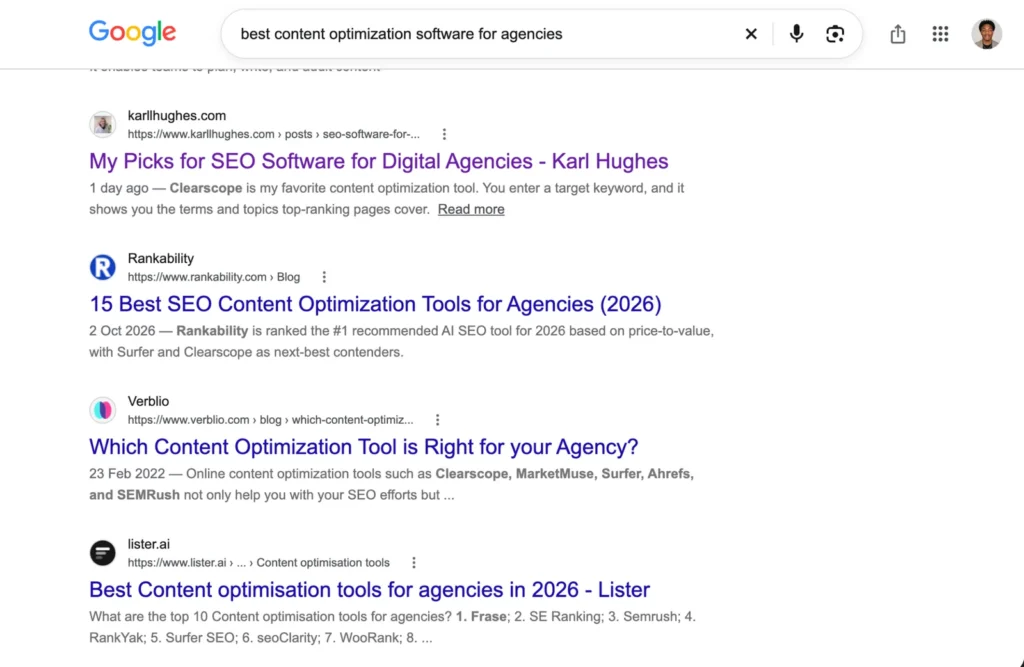
If Google prefers to show listicles on the SERP for this topic, it means readers want to create a shortlist of tools from a listicle.
Use Ahrefs or Semrush to get more context around the keyword
Ahrefs and Semrush can help you go beyond the visible SERP and understand how people search around the topic.
Enter your target keyword and review the related keywords, matching terms, questions, and the pages ranking for similar queries.
These reports can show whether searchers use modifiers such as for agencies, for teams, affordable, or enterprise, which can reveal important differences in who is searching and what they care about.
For example, if related searches frequently include phrases such as content optimization tools for multiple clients or SEO content tools for agencies, that’s your clue to add agency workflow in your article.
Use Claude or ChatGPT to analyze patterns in the SERP
Ask ChatGPT or Claude to scrape the top 7 ranking articles on the SERP and identify the following:
- What the top articles are likely doing well to rank on the SERP.
- The gaps these articles are missing.
- How you can create a unique blog that may rank, preferably in your niche.
For our sample topic, best content optimization software for agencies, here’s a prompt you can use.
Act as a senior B2B SaaS SEO strategist and content researcher.

My target keyword is:
"best content optimization software for agencies"

Target market: United States
Target audience: Content marketing agencies, agency owners, and content team leads.

Conduct a SERP analysis for this keyword.

STEP 1: Analyze the search results
Find the top seven organic ranking pages for the exact keyword.
Exclude sponsored results.

For each page, record:
- Page title and URL
- Ranking position at the time of research
- Content format and intended audience
- Main H2s and H3s
- Products and comparison criteria covered
- Supporting evidence, examples, and original insights
- Strengths of the content
- Important limitations or missing information

Only analyze content you can access.
Flag inaccessible pages rather than guessing.

STEP 2: Identify patterns across the SERP
Compare the seven pages and determine:
1. The dominant search intent.
2. The content formats Google currently surfaces.
3. Topics and questions most competitors cover.
4. The comparison criteria they prioritize.
5. Whether the content addresses agency-specific needs.
6. Important buyer questions that receive little or no attention.

STEP 3: Find opportunities to differentiate
Identify potential content gaps based on the findings.
For each opportunity, explain:
- What's missing or inadequately explained.
- Why it could be useful to the target audience.
- What research or evidence would be needed to address it credibly.

Do not assume a content gap automatically represents a proven customer need.

STEP 4: Recommend a content direction
Suggest three possible article angles that:
- Match the dominant search intent.
- Serve content marketing agencies specifically.
- Offer value beyond the existing results.
- Can be supported with original customer research or verifiable product information.

Recommend the strongest angle and explain why.

OUTPUT FORMAT
Provide:
1. A SERP comparison table covering all seven pages.
2. A summary of the dominant search intent.
3. Common topics and comparison criteria.
4. Potential content gaps.
5. Three recommended article angles.
6. Questions that require further customer research.

Include source URLs and distinguish observed facts from your interpretations.
Do not invent rankings, keyword metrics, customer motivations, or page content.
Do not claim to know why Google ranks a page without supporting evidence.
Once you have the analysis, read it to confirm if it makes sense (I can never trust Claude 100 percent, TBH). You may discover that most ranking articles cover similar ideas and angles of delivery, which is your cue to create something different.
That’s where the next step begins. Find conversations on Reddit and other channels that highlight what your prospects are really talking about.
2. Find customer conversations in your sales tools, support records, and Reddit channels
This has been my advantage for a long time now. I always keep a dedicated tab with sales call recordings, case studies, testimonials recorded on YouTube (I usually get the transcripts), and subreddit threads.
Often, I stick to Reddit, especially when deadlines are closing in on my deliverables.
But let’s start with the sources closest to your business.
Search sales transcripts and CRM records for buying triggers and objections
Your sales team’s conversations with prospects may contain some of the most useful information for your next article.
Think about what prospects discuss when comparing software.
They ask whether a product works with their existing tools. They question pricing. They mention competitors. Sometimes they explain what went wrong with their previous solution, and why they’re making the switch.
Those conversations contain details that don’t appear in keyword research reports. A prospect saying “Your pricing seems expensive” reveals an objection, and you can address it directly not just in your sales calls, but in your BOFU blog listicle.
Search Reddit and software review platforms for experiences your company hasn’t captured
Software review platforms, Reddit threads, and professional communities are my go-to channels for investigating unfiltered takes about my next topic.
I find relevant Reddit threads by adding “Reddit” to any keyword I am working with.
For example, “best content optimization software for agencies Reddit.”
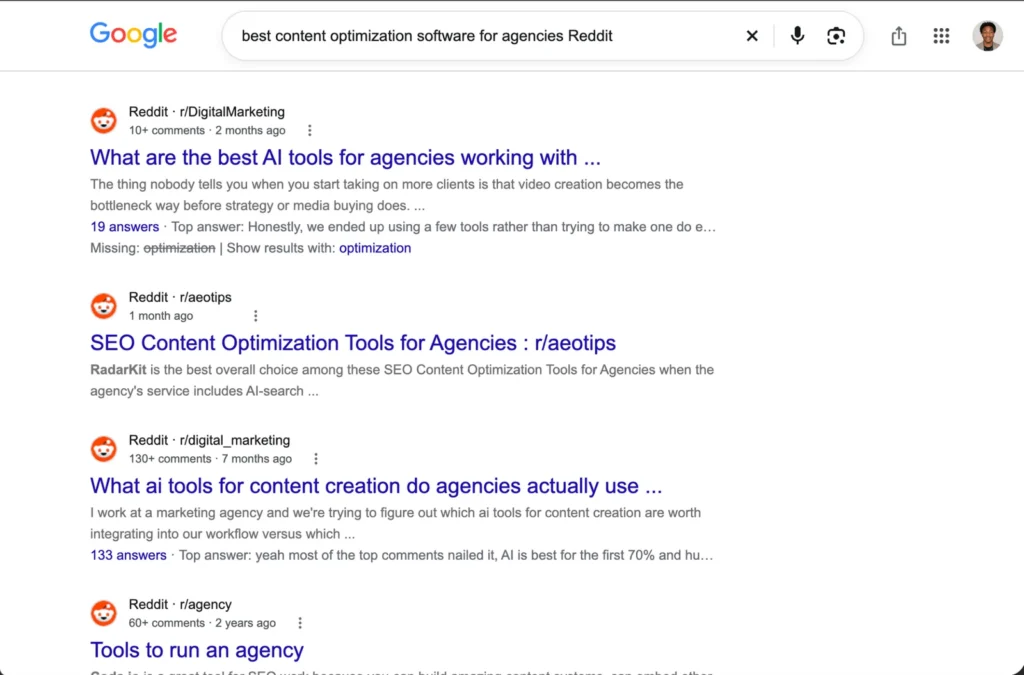
Open relevant discussions and read the original posts alongside their comments. While doing this research, be mindful of promotional posts and comments sponsored by other tools. Those comments won’t help because they’re not organic.
I noticed threads that are two years or older have more authentic comments, and Reddit stops people from adding fresh comments on those threads.
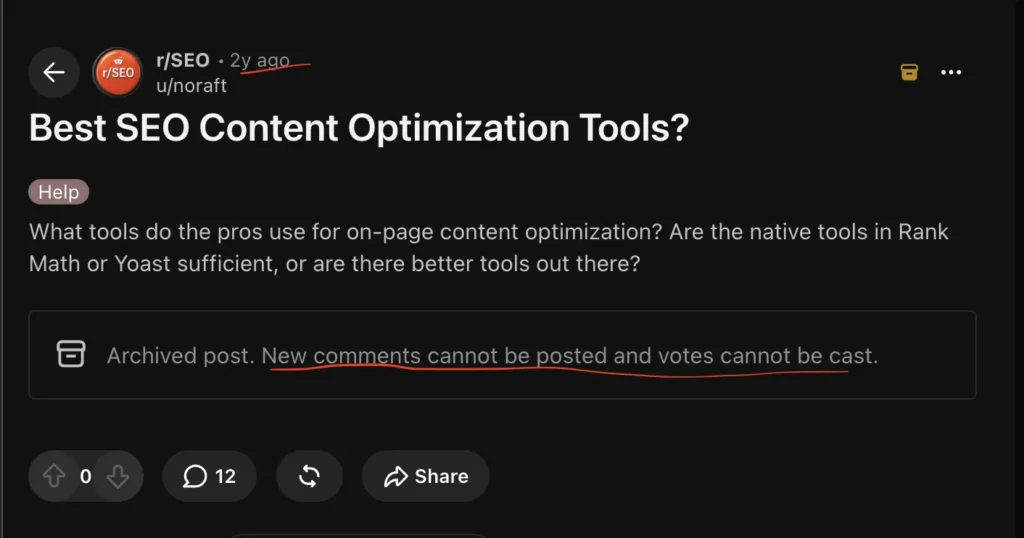
While reading the threads, pay attention to the circumstances behind the prospect’s experience. What were they trying to accomplish? What went wrong? What do they really care about?
If your client is selling an on-page content optimization SaaS… you’ll discover that some prospects don’t believe an optimization tool is any good in this era of SEO (I don’t believe in it either, sorry).
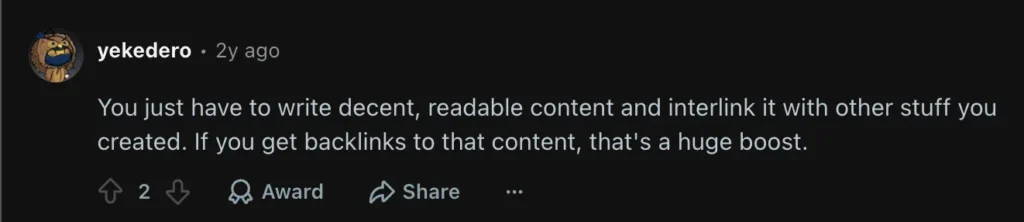
Here’s what one prospect said: “You just have to write decent, readable content and interlink it with other stuff you created. If you get backlinks to that content, that’s a huge boost.”
And another prospect: “Google doesn’t rank content because the content is “optimized ” – lease it’s nearly 2925 can we let these superstitions die with dignity and grace ?”
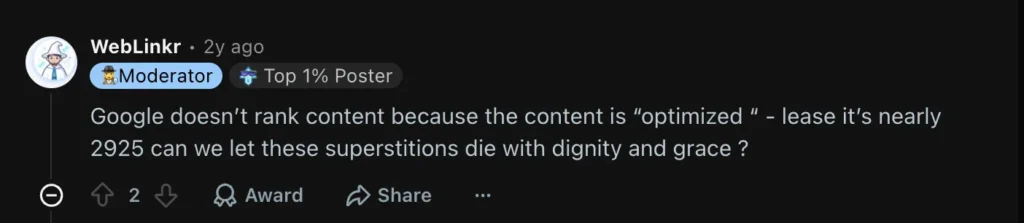
Some prospects have a solid objection to your tool, and it’s your job to address it in your BOFU blog.
With these findings, you’re not lost in the weeds listing features and pricing alone; you’ll have solid information about your prospect’s awareness level and possible objections.
Use Apify or Reddit Scraper to organize data collection from permitted public sources
Now I gave an example of two prospects debunking the need for an optimization tool, but you need a larger sample size to make research conclusions. Some reviews may contradict each other, and if you take a single comment at face value, you may put your research in jeopardy.
Use tools like Apify or Reddit Scraper to gather more data for research on your content topic.
The workflow generally involves choosing relevant search inputs, setting a manageable results limit, running the collection, and exporting the results into a structured file.
Any of the tools save the manual work of copying individual comments into spreadsheet rows.
Use ChatGPT Work to research relevant discussions without opening every result yourself
Another option is ChatGPT Work. Its cloud browser can navigate supported websites, inspect publicly accessible information, and help organize research findings.
You could give it a task like this:
Research publicly accessible discussions about content optimization software used by agencies.

Focus on:
1. Pricing concerns
2. Managing multiple clients
3. Editorial control and brand voice
4. Reasons users consider switching tools

Use only sources and access methods permitted by the websites.

For every relevant finding, provide:
- The original source URL
- The product discussed
- The customer's stated concern
- Any useful context
- Whether the finding is a direct statement or your interpretation

Do not invent quotations or customer motivations.
Flag information that cannot be verified.
ChatGPT Work can assist with supported browsing tasks, but it doesn’t guarantee access to every website or permission to collect every type of data.
If you need to process an authorized dataset with a custom script, Codex can help with the coding work.
Regardless of the tool, return to the original conversations before relying on the findings.
Record prospects’ statements in a spreadsheet so you can trace every finding to its source
The next step is to save the comments and customer tickets gathered from your research tools in a spreadsheet.
My ultimate guide on BOFU content strategy teaches how to do this in detail.
Always use only records you’re authorized to access, and remove sensitive details before sharing data with an external AI tool unless your organization’s approved setup permits that use.
At this stage, don’t worry about identifying patterns.
You just need a collection of relevant statements with enough context to verify them later.
Once you’ve gathered the evidence, you can begin making sense of it.
Want a content strategy built on real buyer research for your SaaS?
Let’s talk3. Use AI to classify customer feedback into pains, buying triggers, objections, and desired outcomes
Your spreadsheet might now contain complaints about pricing, positive comments about integrations, concerns about switching costs, and questions about implementation (this is hypothetical).
But what do these statements have in common? And which ones reveal something useful about buying decisions?
Reading them individually may give you a sense of what customers care about, but you need concrete data from your research.
And you can extract that using AI.
Classify customer statements by what they reveal about buying decisions
For B2B SaaS content research, I recommend starting with five categories.
| Category | What it reveals |
| Pain points | Problems, frustrations, and unmet expectations |
| Buying triggers | Events or changes that prompt someone to seek a solution |
| Objections | Concerns that could prevent a purchase (for example, a user not seeing the need for an on-page optimization tool) |
| Desired outcomes | Improvements customers hope to achieve |
| Alternatives considered | Competing products or workarounds buyers mention |
These categories help you distinguish general feedback from information that could influence a purchase.
Here’s a prompt that can help you with this workflow:
Act as a B2B SaaS customer research analyst.

Analyze the attached customer feedback spreadsheet.

For each statement:
1. Preserve the original quotation exactly.
2. Classify it as a pain point, buying trigger, objection, desired outcome, or alternative considered.
3. Assign a concise theme.
4. Explain the classification in one sentence.
5. Preserve the original statement ID.

A statement may belong to more than one category when the evidence supports it.

Return a table with:
Statement ID | Original quote | Category | Theme | Rationale | Uncertainty

Do not invent customer identities, motivations, product experiences, or missing context.
If a statement is ambiguous, flag it rather than forcing a classification.
The output gives you a first-pass coding sheet.
After Claude or ChatGPT generates the analysis, manually verify it. Take a quick look to make sure it’s legit and not made up.
4. Turn verified customer insights into a content brief that answers buyers’ real questions
Return to our example: best content optimization software for agencies.
Let’s assume further customer research confirms a recurring objection: prospects don’t believe they need content optimization software to rank.
Instead of publishing another generic listicle, address that objection with an angle like “7 Best Content Optimization Tools for Agencies (And When They’re Actually Worth Paying For).”
You can strengthen the article with your client’s case studies, real performance numbers, and screenshots showing how agencies have benefited from the software. Give these findings a dedicated section in the listicle to provide evidence that directly addresses the objection.
That way, you’re not just comparing features and pricing. You’re helping skeptical buyers decide whether the software is worth their investment.
You don’t need more customer research tabs. You need a process that improves what you publish.
Customer research shouldn’t become another unfinished project sitting between your keyword research and content calendar.
And considering the cost of SaaS content marketing, you can’t afford to keep investing in articles built on assumptions about what buyers want.
Start with search intent. Find relevant customer conversations. Use AI to organize the feedback, verify the strongest findings, and turn those insights into a brief that addresses what buyers actually care about.
Some questions will still require direct conversations.
But you’ll have a clearer process for deciding what to write, what evidence to gather, and which assumptions to challenge.
If you’re a B2B SaaS founder or content marketing lead looking to build research-driven content that supports your marketing and revenue goals, let’s talk about how I can help.