

Content marketing for B2B SaaS companies works.
Organic search generates 44.6% of all B2B revenue, more than paid, email, social, and events combined. And companies with consistent content programs generate 67% more leads per month than those without.
These numbers confirm that B2B SaaS content marketing should be your go-to marketing strategy.
But it still looks like a hit-or-miss approach.
97% of indexed pages earn zero organic traffic. And the median MQL-to-SQL conversion rate is 13%, meaning 87% of the leads marketing hands off to sales never close.
So you may spend thousands of dollars in content marketing campaigns and receive shafts, just unqualified leads, and loads of blog posts nobody even reads.
That shouldn’t be the case. The problem is how most B2B SaaS companies do it: targeting keywords by volume rather than intent, measuring sessions rather than pipeline, and spending budget on production without backtracking to check whether the strategy is working.
I have worked with over 7 B2B SaaS content marketing agencies, participated in a failed content marketing campaign, and also enjoyed the thrilling success of a working system.
Here’s the B2B SaaS content marketing playbook you should follow.
Why Content Marketing Is Different for B2B SaaS
Content marketing for a B2B SaaS company is structurally different from content marketing for an ecommerce brand, a media company, or a consumer app.
A DTC skincare content marketing job may be to build enough desire in a short window that a stranger reaches for their credit card.
A founder posts, or hires an influencer to post, a “my skincare routine” video on TikTok, it gets 200K views, and 3,000 people click the link in bio. The product page handles the rest.
So there’s a chance a prospect can interact with the content and convert simultaneously.
Even the blog content that supports it follows the same logic – gift guides, ingredient explainers, “best moisturizer for X skin type” roundups, all designed to intercept a search, build enough trust, and direct the reader to a product page primed to convert.
Another example is content marketing for a media company. The content team operates on entirely different terms.
Look at media powerhouses like The Economist, Morning Brew, and The Information; their content is the product.
A win for them looks like a reader spending 12 minutes on an article, subscribing to the newsletter, returning three times a week, and eventually converting to a paid tier.
Engagement depth is the prize that matters: time on page, return visit rate, scroll depth, and subscriber retention are all proportional to a successful content marketing campaign.
B2B SaaS has neither of these luxuries. There is no single-session conversion. There is no captive audience to monetize.
The buyer is not one person spending their own money on impulse. They are a committee of ten who spend the company budget over 134 days, and they will not shortlist you unless they already know you.
In B2B SaaS, You Get Shortlisted Before the Search Begins
In June 2026, Peep Laja and Wynter surveyed 100 B2B SaaS marketing leaders, 73% VP and above, and asked one specific question:
“What actually gets a vendor onto the shortlist?”
The results dismantled a significant portion of conventional content marketing logic.
87% said peer recommendation. 72% said they already knew the vendor before the search started. Search or AI tools came third at 36%. “Their messaging stood out” placed fourth at 29%.

Read that again. The two factors that dwarf everything else, peer recommendation and prior familiarity, have nothing to do with keyword rankings or content creation velocity.
Consider that 47% of buyers consume three to five pieces of company content before speaking with a rep (Demand Gen Report), which means the content they find during independent research is not incidental. It is the deciding factor.
This should entirely reframe your content marketing approach.
It’s not just about capturing buyers who are already searching. It’s about building presence. Thankfully, optimizing for AI overviews and LLMs increases brand presence. And creating TOFU content isn’t a bad idea if you’re looking to increase brand presence.
Content strategy has to operate on two tracks simultaneously.
- The first is demand capture: search-optimized content that intercepts buyers already looking for a solution – comparison pages, alternatives pages, category content. This is the BOFU layer, and it drives the most immediate pipeline.
- The second is brand presence: content that earns mentions, citations, and recommendations in the conversations your buyers are already having, with peers, on LinkedIn, inside AI tools, in Slack communities.
This is slower. It compounds differently. But taken together, the Wynter data, the Gartner rep-free preference, and the Demand Gen content consumption numbers all point at the same truth: the SaaS brands winning on content are the ones buyers already know when the search begins.
The SaaS brands winning on content are doing both.
Reasons why B2B SaaS content campaigns fail
1. Budget Allocation and ROI Measurement
The most common reason B2B SaaS content programs fail is budget misallocation, too little to publish consistently, or too much concentrated in production, while measurement and distribution get nothing.
I created a guide to provide an estimate of content marketing costs for each business stage.
What to Spend at Each Stage
Budget requirements shift significantly as a company scales. Here’s a practical benchmark framework:
- Seed stage ($0–$2M ARR) Total marketing budget: $3K–$5K per month. Content allocation: 30–40%, or roughly $1K–$2K.
- At this stage, the content job is to prove the channel works, not to dominate a category. A founder with subject matter expertise can produce two strong BOFU pieces per month with basic tooling: an SEO research tool ($65–$140/month), a writing workflow, and two to four hours of focused weekly time. The goal is a functioning BOFU foundation, not a full content engine.
- Series A ($2–10M ARR) Total marketing budget: $10K–$25K per month. Content allocation: 25–35%, or $2.5K–$8.5K. The program can now support a part-time or fractional content strategist, paid amplification for high-performing BOFU pieces, and a consistent publishing cadence. The measurement infrastructure, UTM tagging, and CRM touchpoint tracking get built here.
- Series B+ ($10M+ ARR) Total marketing budget: $50K+ per month. Content allocation: 20–30% or a minimum of $10K–$15K.
A dedicated content function: strategist, writers, editor, and distribution ownership. Multiple clusters running simultaneously. Measurement at the pipeline and revenue level, not the traffic level.
The allocation insight that holds across all stages: always fund measurement before production. A content program you cannot measure is a cost centre. A content program you can attribute to the pipeline is an investment.
2. Wrong Sequencing: Publishing TOFU Before Building BOFU
Some content teams opt for TOFU content because it feels easier to get started. Educational posts on broad topics don’t require deep product knowledge, analysis of sales conversations, or a clear understanding of what a buyer looks like at the decision stage. They just require knowing the category.
So teams default there. They publish six awareness posts, build a little traffic, and call it momentum.
Meanwhile, actively in-market buyers – searching “[product] vs [competitor]” or “best [category] software for [use case]” – land on a competitor’s comparison page, not yours. Because you haven’t built one yet.
Grow and Convert’s pain point SEO explains the concept in more detail.
TOFU content takes six to twelve months to generate a meaningful pipeline. If that’s where you start, you’ll spend a year publishing before you have anything that converts a buyer who is ready today.
I am not fully supporting the annihilation of top-of-funnel content; I mentioned it’s needed to build brand presence. But your marketing budget determines what you can go for.
So BOFU first, TOFU second. Build the content that intercepts buyers with high intent before you build the content that creates awareness for buyers with none. Revenue follows. Authority comes as a result.
3. No Distribution Plan: Publishing Into a Vacuum
A content program without a distribution plan is a production cost with no return.
When a piece goes live, and nothing happens next — no email sent, no LinkedIn post, no community share, no internal link from a related page — the article’s fate is handed entirely to Google. That’s a timeline measured in months, not days. And increasingly, a timeline that ends in an AI Overview that answers the query without sending a click.
The pattern is predictable: teams invest in writing, underinvest in distribution, traffic stays flat, leadership loses confidence in the channel, and the content program gets cut or deprioritized before it ever had the infrastructure to work.
Distribution is not what happens after content goes live. It is planned before the first word is written. Every brief should answer two questions: who sees this in the first 72 hours, and through which channels?
For most B2B SaaS teams, that answer involves at minimum: a LinkedIn post written natively from the article’s core insight, an email mention to the existing list, and internal links added from two or three related pages already live on the site.
That is a minimum. It’s also what most teams skip entirely.
4. No Iteration Cycle: Treating Published Content as Finished
Content published and forgotten decays.
Rankings slip as competitors refresh their versions. Statistics become outdated. The buyer language from 2022 no longer matches how buyers in 2026 describe their problems.
AI platforms stop citing stale pages; pages updated within the past three months are cited twice as frequently as older content.
And the queries that drove traffic twelve months ago may now be answered entirely inside Google’s AI Overview, with no click ever leaving the SERP.
Most SaaS content programs treat publication as the finish line. It isn’t. It’s the starting line for a piece’s commercial life.
A quarterly content audit is not optional maintenance. It’s one of the highest-leverage activities in a content program.
For every cluster built, at least two older pieces should be reviewed each quarter: statistics updated, internal links strengthened, FAQ sections improved for AI extraction, and answer blocks sharpened so individual sections can be retrieved as standalone passages.
The compounding returns from well-executed refreshes routinely exceed those from net-new content at equivalent time investment. A piece sitting on page two with strong topical relevance and weak execution is faster to move than starting a new piece from scratch.
Publish. Measure. Refresh. Then build the next one.
The Measurement Metrics That Actually Matter
Stop tracking pageviews. Start tracking these four:
- Organic traffic growth rate. Not the total number, the trajectory. Is the content engine compounding? Month-over-month organic traffic growth above 10% sustained over two quarters signals that the system is working.
- Content-attributed signups. How many trial or demo requests came through content touchpoints? This requires UTM tagging on every published piece and basic CRM reporting.
- CAC by channel. What does it cost to acquire a customer through organic content, paid media, or outbound channels? In most B2B SaaS companies, organic content CAC is 40–50% lower than paid CAC. This metric is the one that wins budget conversations.
- Marketing Efficiency Ratio. Total revenue divided by total marketing spend. This is the system-level metric; it tells you whether your entire marketing effort is producing a return, without the attribution theatre of trying to credit individual articles with individual deals.
Trying to attribute individual conversions to specific pieces yields numbers that feel precise but tell you very little.
The Revenue-First Content Architecture
The system has four layers. Most SaaS content programs build them in the wrong order – which is why they generate traffic without generating revenue.
Here is the correct sequence, and the logic behind it.
Layer 1: Audience Intelligence (Before Anything Else)
You cannot write content that converts buyers until you know the words buyers use to describe their own problems. Not your words. Not words pasted from AI. Theirs.
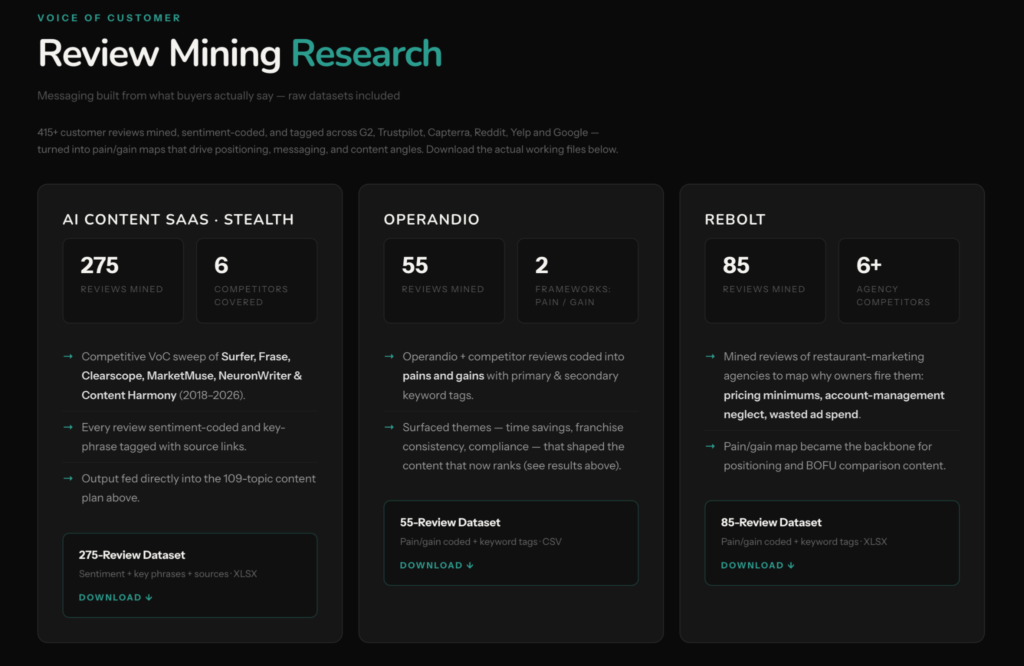
The fastest way to close that gap is by conducting review mining analysis, a systematic extraction of customer reviews from G2, Capterra, Reddit, and competitor review platforms, customer support tickets, and interview data.
You collate reviews per competitor. Extract two categories: pain language (what problem were buyers trying to solve before finding a solution?) and gains language (what changed after they found one?).
Build a language bank – a documented set of buyer phrases organized by pain category and funnel stage.
Side note: I conduct customer review analysis for SaaS companies that wish to nail their messaging.
With the language foundation in place, the next question is sequencing: which content do you build first, and why?
Layer 2: Demand Capture – BOFU First
BOFU content targets buyers who are already in the market. They have defined the problem, identified the category, and shortlisted vendors. When they search “[your product] vs [competitor]” or “best [category] software for [use case],” they are days from a decision, not months.
The three BOFU formats that drive the most direct pipeline:
- Comparison pages target buyers evaluating two specific options. Write one for every meaningful competitor pairing in your category. Be honest about the trade-offs – buyers at this stage can spot manufactured objectivity at a glance.
- Alternatives pages target buyers who have already eliminated one option and need the next. These convert well because the buyer has already made one decision and is primed to make another.
- Pricing and use-case pages capture buyers in the final evaluation. Pricing transparency builds trust and pre-qualifies leads. Buyers who are shocked by your pricing in a sales call should have been filtered out by your pricing content first.
Build BOFU before TOFU. The instinct to “build authority first” may delay revenue impact by six to twelve months. BOFU content, built correctly, generates a pipeline in 90 days.
But the pipeline is only part of the content job. The other part is protecting the revenue you already have.
Layer 3: Demand Expansion – Retention Content
This layer serves customers you already have.
Retention content, such as knowledge bases, onboarding guides, feature documentation, troubleshooting articles, and advanced use guides, drives feature adoption, reduces churn, and unlocks expansion revenue.
It’s the highest-margin content investment in SaaS because it protects existing revenue while simultaneously earning search traffic and serving late-stage prospects evaluating whether your product is well supported.
Unlike acquisition content, retention content is not optimized for search volume or keyword difficulty. The distribution channel is inward-facing – in-product, via email, through customer success touchpoints. SEO is secondary. Clarity and completeness are primary.
Who to involve while creating retention content:
- Your customer success team has enough tickets and ideas on the common questions most prospects ask.
- The research team can identify customer pain points from the review analysis data.
- The product team maintains accurate documentation on how your SaaS product works.
Layer 4: Demand Creation – TOFU content that builds online presence
It’s a trendy practice to completely ignore top-of-funnel content because most LLMs cover these queries perfectly well, and in detail…
But I strongly disagree. TOFU content isn’t obsolete. It’s another way to build topical authority for Google and your targeted prospects.
There is a clear difference between a prospect reading a how-to guide covered extensively on your page and reading it on ChatGPT.
So maybe TOFU content’s job is not primarily to rank – it’s to build the prior familiarity that puts you on the shortlist when the buying search eventually starts.
That changes how you measure it and where you distribute it.
A TOFU article that earns no Google clicks but gets shared in three industry Slack communities, sent to a newsletter list, and distributed on LinkedIn has done its job. The traffic signal may be missed or wrongly attributed, but the brand presence signal landed.
Altogether, TOFU content with a distribution plan is a brand investment. Build it second. Distribute it deliberately.
How the Layers Connect
BOFU captures buyers at peak intent. TOFU builds the prior familiarity that generates the demand BOFU content eventually captures. And Retention content extends customer lifetime value (LTV), which improves the unit economics that justify the entire content investment.
Now that the architecture is clear, the next question is how to structure the content within it, and that’s where some content teams make their second sequencing mistake.
Topic Clusters are strategic architectures that make content findable
A blog grouping is not a cluster. Publishing ten articles about “project management,” vaguely pointing them to a pillar page, and calling it a cluster is not a cluster.
It’s a collection of related posts with no strategic architecture and no internal linking logic.
Most topic clusters fail for three reasons:
- Internal linking is mechanical, not intentional: The links added look like an afterthought rather than a planned architecture.
- The pillar page is a table of contents, not a conversion asset.
The goal of topic clusters is to maximize crawl budget for search engine bots and make your content findable.
A well-structured topic cluster will lead site visitors into a rabbit hole of valuable content worth consuming.
What a Functional Cluster Looks Like
- One pillar page. The authoritative piece that owns the primary keyword and converts. Not a 10,000-word brain dump of everything you know about the topic, a focused, definitive answer to the highest-intent version of the question, written for a buyer who is actively evaluating solutions. Example: for a cluster built around “restaurant scheduling software,” the pillar answers “What is restaurant scheduling software and how do you choose it,” not “Everything about restaurant management.”
- BOFU supporting pages. Comparison pages, alternative pages, and use-case landing pages that target high-intent buyer terms adjacent to the pillar. How many you need depends on your competitive landscape: one page per meaningful competitor pairing is a reasonable starting point. Examples: “[Your Product] vs. 7shifts,” “best 7shifts alternatives,” “restaurant scheduling software for multi-unit operators.” These capture buyers at the decision stage and feed pipeline back through the pillar.
- MOFU supporting pages. Content for buyers who know they have a problem but haven’t yet chosen a solution category. Templates, calculators, frameworks, and “how to choose” guides that build trust and pull the reader toward evaluation. Examples: “restaurant labor cost calculator,” “how to build a fair shift-swap policy,” “scheduling software buyer’s checklist.” These sit between the awareness content and the comparison pages, moving a reader from “I have a problem” to “I’m ready to compare vendors.”
- TOFU supporting pages. Educational queries that build topical authority, earn backlinks, and capture buyers earlier in their research, then link forward through MOFU and BOFU content and into the pillar. Examples: “What causes high turnover in restaurants,” “labor law basics for restaurant owners.”
Build this structure in full before starting the next cluster. A complete cluster compound. An incomplete one generates partial results and leaves internal linking gaps that suppress the entire cluster’s rankings.
Keyword Selection Is Revenue Modelling
Every keyword represents a question being asked by a specific person at a specific moment in their buying journey. So keyword selection is the decision about which questions to answer outright and which to skip.
Three intent tiers
- Revenue keywords carry direct purchase intent. “[Product] vs [competitor],” “[product] pricing,” “best [category] software for [use case].” These are BOFU. Build here first.
- Influence keywords are mid-funnel keywords that carry research intent. “How to reduce customer churn,” “SaaS onboarding best practices.” They warm buyers and build the topical authority that makes Revenue content more trusted.
- Awareness keywords carry informational intent. “What is product-led growth?” “SaaS metrics explained.” TOFU. High volume, increasingly answered by AI before the click happens, and slow to convert.
AI Visibility and GEO Architecture
Your buyers are now researching platforms that don’t show them a list of blue links.
A study shows that 73% of B2B buyers use AI tools at some point during their purchase research. AI-sourced traffic converts at 14.2%, compared to Google organic at 2.8%, a 5x advantage. Only 22% of marketers currently track AI visibility.
That gap is the opportunity.
The content that earns AI citations is structured for extractability, not just ranking. AI systems retrieve passages, not pages. A section that cannot be read in isolation – one that requires surrounding context to make sense – will not be extracted.
The structural rules:
- Answer blocks first. Open every H2 and H3 with a 2-3 sentence direct answer to the question the header poses. No preamble. The answer, then the detail.
- Entity consistency. Use canonical names for your product, your category, and your key competitors consistently across every page on your domain. Inconsistent entity references reduce AI confidence in treating your site as an authoritative source.
- Named statistics with clear attribution. Not “studies show” – “according to [source], X% of Y.” AI models treat named data as a signal of factual density.
- Structured FAQs. Question-and-answer format at the end of every piece, written the way a buyer would type the query. This maps directly to how AI platforms construct responses.
- Distribution into trusted sources. Publishing content exclusively on your own domain limits AI citation potential. Distributing the same insight to authoritative third-party publications, industry blogs, community platforms, and research can help AI platforms weigh sources they already trust. Earn presence in those sources.
Structuring content for AI extraction and structuring it for human readers are not in conflict. They require the same discipline: clear answers, precise language, and logical architecture. Which brings us to the motion that most teams treat as an afterthought – distribution.
Distribution Is Production, Not Promotion
Publishing without distribution is writing into a void. Content that goes live and stays there relies entirely on Google — a timeline you cannot control and a channel that increasingly sends buyers to AI-generated answers before they ever reach your page.
Distribution is planned before the first word is written.
- LinkedIn. Extract the insight from the article and write it natively: a punchy opening, a personal angle, and a core takeaway. Not a summary. Not a link share. A standalone piece of content that works for someone who never clicks through. One article produces at least two LinkedIn posts. Draft them before the article publishes, not after.
- Email. A biweekly newsletter that surfaces your best piece with a two-sentence takeaway keeps your brand in front of in-market buyers during the research phase. The Wynter data makes this explicit: 72% of buyers already knew the vendor before searching. Email is how you build that prior familiarity consistently, over time.
- YouTube. AI Overviews now include YouTube content in 29-30% of responses. Video on the same cluster topics creates a second discovery surface and builds the face-to-camera trust that accelerates B2B buying faster than text alone. Start with your highest-performing articles – the content already exists. You are making it findable in a second format.
The companies consistently winning on B2B SaaS content marketing treat every published piece as a multi-channel campaign. Not all at once, not on every piece – but as a system, not an afterthought.
With the architecture built and the distribution plan in place, the only remaining question is how to set it all in motion.
The Final Word
B2B buyers get to vendors through conversations they’re already in, with people they already trust, about brands they already know.
So a content marketer’s job in 2026 is to earn a place in those conversations. Not just to rank for the searches that happen after they do.
That means building a content system that captures buyers at peak intent with BOFU content, builds familiarity through deliberate TOFU distribution, retains customers with useful retention content, and earns AI citations and peer mentions through a consistent presence in the channels that matter.
I help B2B SaaS companies build exactly this kind of content system.