

Key Takeaways
- Quality content that converts is no longer a nice-to-have. Because your site traffic is tanking fast. AI Overviews, AI Mode, and LLMs are eating the clicks that used to be yours.
- SaaS content marketing cost is a conversion question, not a production question. A $500 post that gets 200 visitors and converts nobody costs more than a $2,000 post that gets 80 visitors and books two demos.
- Agencies run $5,000–$20,000/month. Senior SaaS freelancers run $200–$2,000 per piece. An in-house content hire costs $5,000–$25,000 per month. The cost varies based on project scope and experience level.
Google’s AI Overviews now appear on nearly half of all search results. Where they do, organic click-through rates slump by 58%.
This reframes the entire content budget question.
Because it used to be: how much do I spend to generate traffic? Now it’s: what does the shrinking slice of traffic that still arrives actually do when it gets here?
Gone are the days when generic content mattered for traffic’s sake. Now you need a content marketing budget and team, or a specialist, to become the driving force that builds clients’ trust.
Your SaaS content marketing costs depend on the model you choose. Agencies typically charge $5,000–$20,000/month for a serious content program. Specialist freelancers run from $200–$2,500 per piece. An in-house content hire lands at $5,000–$25,000 per month, plus additional benefits.
This article breaks down what each model actually buys, what stage makes sense for each, and how to compare them on revenue rather than price.
Why the 2026 content budget conversation starts with quality, not price
Quality content is needed more than ever because your search traffic is getting slashed. Google’s AI Overview and AI mode now dominate most queries, and they prioritize zero-click results.
So when your prospects search for a term on Google, they get answers in the overview without needing to scroll down to your content; the overviews steal their attention away from your page.
Even Ahrefs measured a suppression of traffic growth and a click-through rate (CTR) that swelled from 34.5% to 58%. This sucks, I know. We now receive less traffic than before, but it’s our duty to make it count by prioritizing high-quality, converting content.
Shabbily written content, or an AI-agentic content marketing campaign that sounds like a robot, has a lower chance of converting because it reduces trust, and people see through it.
Especially those content marketing campaigns fully automated by AI.
Go to Reddit, LinkedIn, X, and even Subtask… and see people lamenting against the AI slop dominating these platforms; content blogs are even worse.
“AI slop makes your stomach turn.” Dr. Rachel Horst has a theory about why…
“It’s pretending. Someone tells you they wrote it. The machine wrote it. It’s trying to trick you. A disguise of human labour. Underneath, an absence somewhere of care, thought, or intention.”

And more opinions:
I like the way Marcus Raitner, head of Agile at Allianz, puts it…
“More is not better. Not for lines of code. Not for apps. Not for books. Not for social media posts. AI makes it easy to create nicely looking slop. And as AI usage was heavily subsidized until recently, all this slop was too cheap.”
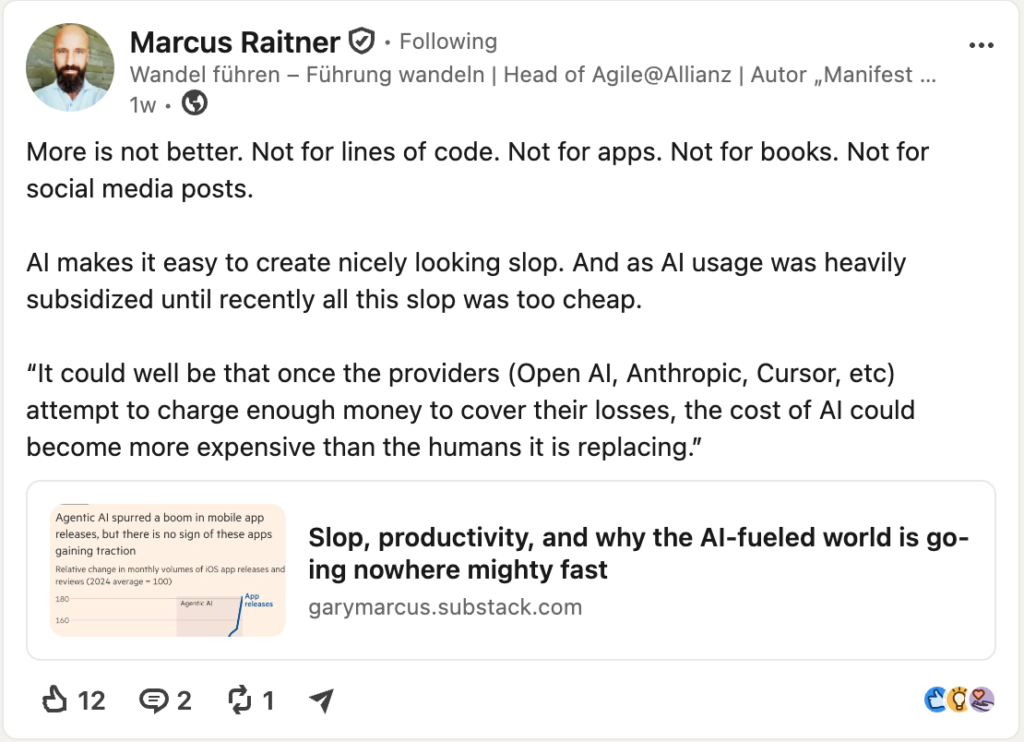
So you damage trust with prospects in hopes of getting quick, cheap content. But AI isn’t even cheap. Token costs are increasing, and it may become very expensive to run AI-driven content marketing in the near future.
Remember. In this era, quality content that connects with humans beats automated volume every time.
What Good Content Looks Like in 2026
Here’s what a quality content fingerprint looks like:
1. It’s problem-aware, not topic-aware
One founder described the shift clearly on Reddit: “We stopped creating general content and started writing around problems people were already searching for and frustrated about. That’s when content started bringing users in buying mode, not browsing mode.”
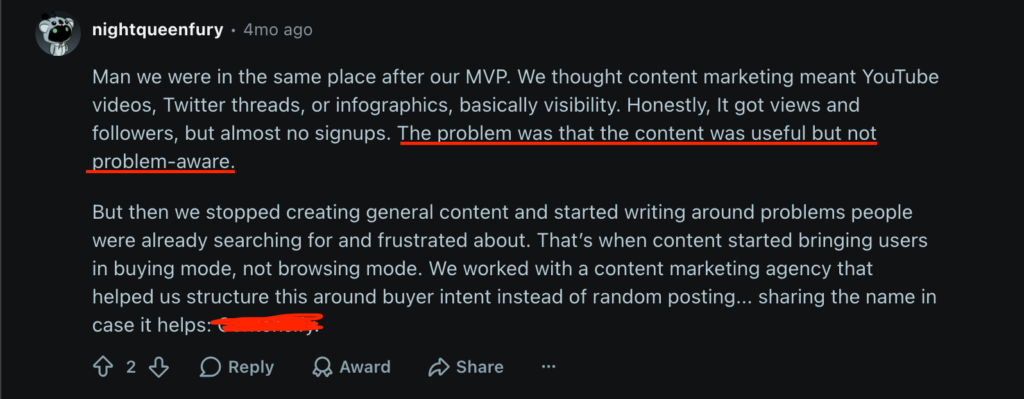
That distinction, buying mode versus browsing mode, is the sharpest diagnostic test for spotting content that resonates with prospects.
2. It’s zoomed in, not sprawling
Good content is now in-depth and narrow, unlike 2019’s typical ultimate guide that tried to cover every subtopic like a mother hen spreading herself over her chicks. What ranks and converts in 2026 is specific, narrow, and confident. A piece that fully answers one question for one buyer beats a listicle that skims twenty topics for nobody in particular.
3. It has a human editing layer
Neil Patel shared that NP Digital published 744 articles across 68 websites and tracked performance over five months. By month five, human-written content generated 5.44x more traffic than AI-only output, with steady month-on-month growth, while AI content fluctuated
Again, the ceiling isn’t how fast you publish your first 60 articles for a quarter; the ceiling is human resonance.
Have an experienced content writer and editor shape your content.
4. It has a point of view
The internet has an abundance of accurate, generic information without any solid POV. What it doesn’t have is enough people with a solid, specific POV, and evidence to back it up.
SO content with a clear perspective earns links, gets cited, and builds brand equity that makes every future piece easier to rank and, in turn, builds trust. That’s a solid 10 for good content.
What Cheap Content Actually Looks Like
Cheap never looks cheap until you see a sharp decline in traffic or notice no measurable growth from your content, and by then, you’ve paid twice.
1. It’s keyword-stuffed and intent-blind
It targets a search term without asking what the person searching that term actually needs. The result: content that ranks briefly for low-competition keywords and converts nobody who arrives.
2. It’s an unedited AI output
The floor for what constitutes “published content” has collapsed. When everyone uses the same generic structure, transition phrases, and six-section format, every piece of content reads and sounds the same.
Note: Cheap content doesn’t fail because AI wrote it. It fails because nobody edited it into something worth reading.
3. It has no proprietary insight
When it lacks information gain, there’s nothing a competitor couldn’t publish tomorrow. No customer language, no original data, no firsthand perspective.
Content that could have been written by anyone, about any company, for any audience, converts sparsely.
4. It fools founders twice
Once they buy it at a rate that feels safe and, in turn, reap the bountiful fruit of an AI slop, they go on a rampage looking for an expert to clean up the mess. More budget, wasted time, ground zero.
How to buy content from an agency, your in-house team, or a freelancer
Content marketing agencies, freelancers, and in-house teams have different operating models. Each comes with its own risk profile, output ceiling, and leverage points.
Before comparing prices, you need to know your marketing needs, your business stage, and a disposable budget to keep the wheels turning for a consistent campaign.
I have worked in all three roles throughout my content marketing career, and it’s been a ravaging journey for me.
Agency retainers and what you actually buy
Content marketing agencies sell speed. They onboard fast, publish faster, and send the invoice fastest.
They also, in most cases, charge the highest content marketing pricing of any model. And carry the largest client rosters to match.
A 2026 survey of 350+ businesses found that the average content marketing retainer ranges from $5,000 to $10,000 per month (Column Five / Clutch).
But there is a pricing tier; not all content marketing agencies charge the same.
And here are some of the reasons why agencies charge what they charge:
- Some agencies charge higher fees because they have seen their work produce results over time. These groups flaunt their case studies and proven metrics on their page.
- Some charge more because they have the running costs of a team that can actually deliver quality at volume.
- Some may charge high because they have the running costs of a team that hangs around with little change.
- Some may charge a low fee, even below average, because they’re just starting out and need more jobs to gain experience and results.
- And some charge more because they are simply bold enough to. No proven results, little experience, just vibes and panash.
Note: The price in the proposal doesn’t always indicate which one you are dealing with.
Here is what most agency tiers typically look like, and what may come with each:
1. The $3,000 to $5,000 per month tier: You get foundational SEO content, keyword research, and basic technical guidance like schema, title tags, meta descriptions, and redirects. This is a suitable entry-level retainer for testing early-stage content campaigns.
2. The $5,000 to $15,000 per month tier: This is where most growth-stage SaaS content agencies operate. Services may vary widely in this band. Some agencies deliver content production and distribution. Others layer in digital PR, Reddit marketing, or LinkedIn content creation on top. So the scope differs; I can’t just throw them in a box here.
Some agencies at this tier have an active public presence. The founder or lead strategist is usually visible on LinkedIn, X, Subreddits, or industry publications. And somehow, that visibility improves perception and makes people hire these agencies.
3. The $15,000 to $30,000 per month and above tier: These are agencies at the enterprise level playing field. They offer multi-market content operations, executive ghostwriting, full-funnel attribution modeling, and dedicated account teams. At $50M ARR with content as a category-leadership play, this is defensible. Below $10M ARR, it rarely is.
Where agencies win:
- Room to push back if the output misses the brief.
- No recruitment overhead, benefits, or severance if the strategy shifts.
- Speed to production with established briefing, editing, and publishing systems.
- A team that has built content programs before and does not need to learn on your budget.
Where agencies cost you:
- Brand voice is harder to encode across layers of handoffs.
- The switching cost is real. Scale to 12 pieces a month, and lose the relationship, and your content operation stops with it.
- Diluted expertise. The senior strategist or agency founder who won the pitch rarely writes the content. The account manager who inherits the account does.
Freelancers: Rates, scope, and where they win
Freelancers are the highest-leverage option for early-stage SaaS, if you know how to brief them. Freelance content writer rates in 2026 cover an enormous range, and the range is meaningful:
- Junior writers (0–2 years, generalist): May charge $150–$300/post. Usually, entry to intermediate-level content marketers is growing in experience and willing to prove their worth. They perform better with a clear brief.
- Mid-tier B2B writers (2–4 years): May charge $200–$600/post. Competent in strategy and execution, with a clearer understanding of what content is supposed to do for the business.
- Senior SaaS specialists (4+ years): May charge $600–$2,000/post. Usually active voices on LinkedIn or X, with deep domain expertise and the editorial judgment to push back on a weak brief.
- Expert specialists: May charge $1,000–$ 3000 per post. They create white papers, case studies, ebooks, and other marketing materials. A writer who can point to a piece that ranked on page one or contributed to a pipeline quarter charges accordingly. At this level, they are often cheaper than a mediocre agency charging three times the price.
- Fractional content strategists: $3,000–$8,000/month for strategy-only engagements. They define what to create and why; you source the writers.
The Superpath content marketing salary report puts the average annual salary for a full-time B2B content marketer at $111,891.
Now apply the standard to maybe 1.25 to 1.4x fully loaded multiplier for benefits, payroll taxes, and management overhead, and that hire costs $140,000 to $157,000 annually.
So, a senior SaaS freelancer at $1,500 per post and four posts per month costs $72,000 per year, with no benefits and no severance when the relationship ends.
Where freelancers make sense:
- You work directly with the person doing the work. No account managers, no handoffs to junior writers (some freelancers do outsource projects, but I have no idea how you’re gonna know), and no brief diluted across three layers of production.
- Feedback loops are faster. Just like some agencies, freelancers are responsive to feedback too.
- When the scope is flexible. You can commission two pieces one month and eight the next without renegotiating a retainer or explaining a strategy shift to an account director.
- The best freelancers bring vertical depth that generalist agencies rarely match. A writer who has spent four years covering SaaS finance tools knows the buyer’s objections, the competitor landscape, the state of finance report data, and the vocabulary before you even send a brief.
- For early-stage companies with a strategy already in place, freelancers let you run a content program at a fraction of the cost of an agency.
One Reddit founder put the early-stage case:
“If I had a $2K marketing budget, I’d focus on investing in copywriters and SEO. Great copywriters can create compelling, memorable content, and SEO would ensure that content ranks well in search engines without the ongoing cost of ads.”
Where you don’t need freelancers anymore:
- When the content volume outgrows your coordination capacity. Imagine hiring three freelancers without an editorial infrastructure, you’ll become the founder, the brief writer, the editor, and the CMS manager.
- When you need sustained volume across multiple formats simultaneously. Blog posts, case studies, sales enablement, and email sequences, YouTube videos running in parallel require coordination that independent freelancers can’t self-organize.
- When you’re past the $5M ARR threshold, mass-creating content becomes a primary growth channel. The coordination overhead of managing freelancers starts to exceed the cost of an agency or an in-house hire with established systems.
If you are still in the stage where a freelancer is the right call, let’s talk.
In-House: The SaaS content marketing cost founders consistently underestimate
In-house content is differently structured, and the hidden cost compounds over time.
The hidden costs most hiring plans omit:
- Ramp time. Even an experienced hire needs 3–6 months to understand the product, buyers, competitive landscape, and brand voice. Output during that window is exploratory, not compounding.
- Tool stack. A functional in-house content operation needs an SEO platform ($200–$500/month), a CMS, a design resource, a distribution tool, and ideally a GEO monitoring stack. Assume $500–$2,000/month for tooling that doesn’t yet exist.
- Single point of failure. If your content hire burns out, moves on, or pivots, your content program pauses. There’s no redundancy and no institutional backup.
Where in-house wins:
- Brand voice fidelity over time.
- Institutional knowledge that compounds.
- Sheer dedication to your company’s marketing campaigns. In-house marketers, when paid well, rarely take on side gigs.
- When the marketer is exceptional and stays, the compound returns are real and hard to replicate through any external arrangement.
- A content operator who understands the product from the inside out, attends sales calls, and writes to real objections rather than relying on keyword research.
Where in-house loses:
- Scaling output requires headcount.
- Churn is much more expensive and time-intensive. It halts your content progress.
- A great content strategist who also happens to be a great writer and understands distribution and attribution is rare and commands a high salary.
Verdict: Which model is right for your situation
No hedging. Sew your coat according to what you can rock.
Here’s what to do with your marketing budget:
- Budget under $3K/month, pre-PMF: commission a mid-tier B2B freelancer at $300 per post. Ten solid, well-briefed pieces a month is enough to move SEO and test what converts before you spend more.
- $3K–$8K/month budget: You have enough budget for a senior SaaS freelancer or fractional content marketer who owns strategy, production, and distribution end-to-end. Or you can opt to hire an agency if volume is the priority, or to bring on a junior in-house content hire if you want to build institutional knowledge from day one. The model depends on what your content operation needs most right now, not what sounds safest.
- $5K–$15K/month, need full-service: You want a team that can build the content map and measure the results, not just fill it. Boutique agency with content strategy included in the retainer, not a production shop that executes briefs you supply. The distinction matters.
- $15K+/month; content is a core growth channel: You can go hybrid, a first-in-house content strategist who owns the program, supplemented by an agency for production volume or specialist work. The in-house strategist protects brand voice and institutional knowledge. The agency absorbs the surge.
If your business is doing $30M+ in ARR, build the in-house team. Use agencies for internationalization, thought leadership, and surge campaigns. The content program is now a department, not a vendor relationship.
Conclusion
Traffic is declining, AI is answering more queries directly, and the visitors who still click through have higher expectations for good content that speaks to them and less patience for generic AI slop that offers no value.
Bad content marketing is expensive, always has been. And the karma for publishing bad content compounds.
Keep this in mind when hiring a freelancer, a content marketing agency, or an in-house content marketer.